Automotive Aptitude — Paint Correction in LA & Orange County
What Paint Correction Actually Is
Paint correction is machine polishing that permanently removes the swirl marks, haze, and light scratches sitting in your clear coat. Nothing gets filled or covered up — the surface is leveled until the reflection turns sharp again, which is why corrected color looks deeper than any wax could make it. It’s measured work: paint thickness gauge first, a test spot to find the least aggressive combination, then panel by panel.
Machine polishing that permanently removes swirls, haze, and light scratches from your clear coat. Not filled, not hidden — gone. Measured, panel-by-panel work.
The Process
Five stages, every time. Tap a stage to see what happens in it.
Five stages. Tap one to read it.
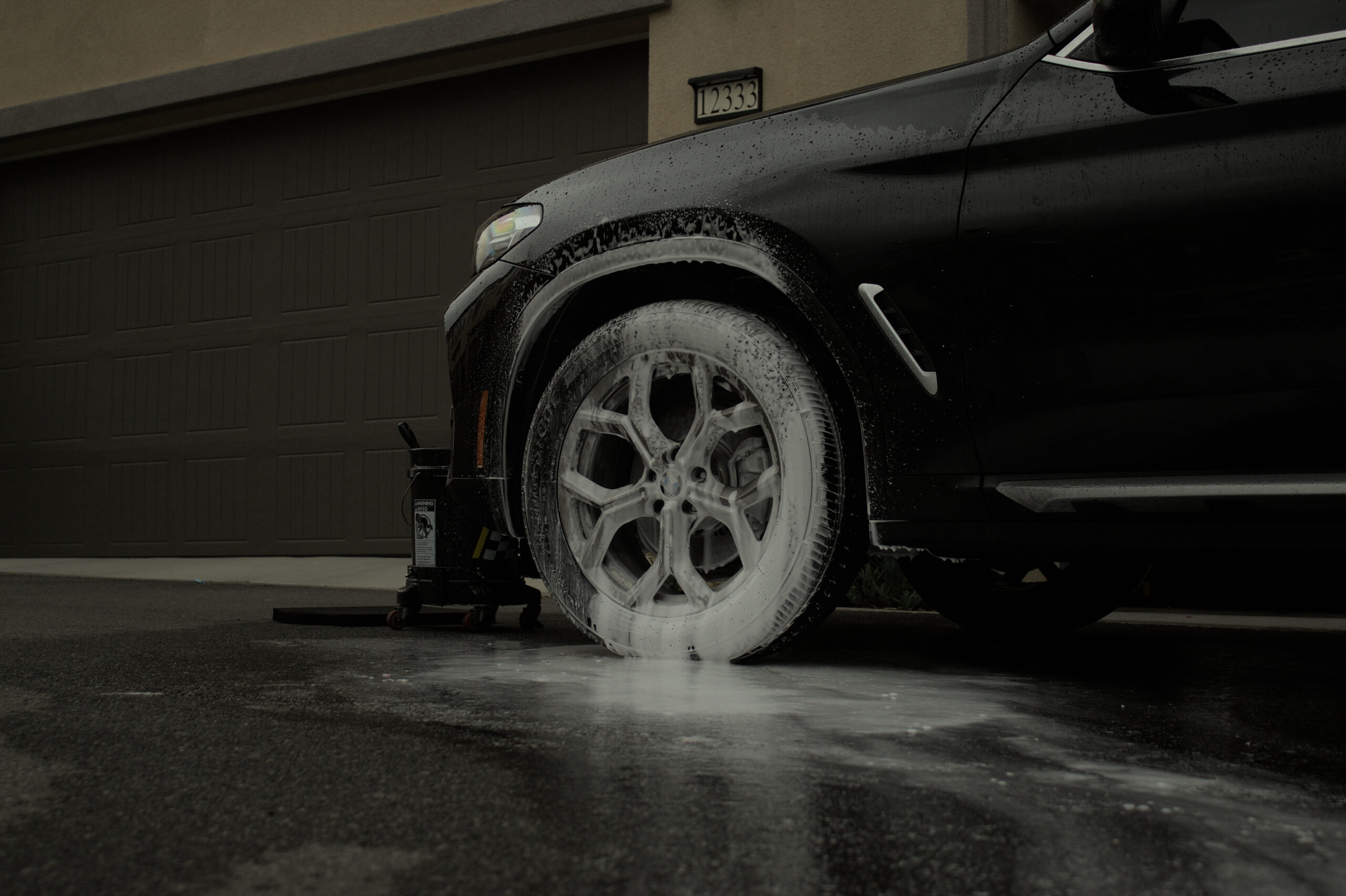


 Stage 1 of 5
What Polishing Actually Does
Your clear coat is far thicker than the scratches in it. Correction refines just the top few microns — enough to clear the damage, and no more.
What correction cannot fix.
Polishing works inside the clear coat. Once damage goes past that layer, no amount of machine time brings it back, and I will tell you that before you pay for anything.
Polishing works inside the clear coat. Past that layer, nothing brings it back.
Clear coat that has already failed
Peeling, flaking, or that chalky white haze on a roof or hood means the clear coat is gone, not scratched. Polishing what is left only takes away more of it. That is a repaint, not a correction.
Peeling, flaking or chalky white haze means the clear coat is gone. That is a repaint.
Scratches that catch your fingernail
Run a nail across it. If it catches, the scratch is through the clear coat and into the color underneath. I can soften how it reads in the light, but I cannot remove it.
If a nail catches in it, it is through the clear coat. I can soften it, not remove it.
Rock chips, dents and cracks
Chips on the front bumper and hood are missing paint, not scratched paint. Same with dents and stone cracks. Those belong to a body shop or paint protection film, not a polisher.
Chips and dents are missing paint, not scratched paint. Body shop or PPF, not polish.
Deep etching and hard water damage
Bird droppings and sprinkler minerals left through a summer can eat a crater into the clear coat. Shallow ones polish out. Deep ones leave a mark you can still see at the right angle.
Droppings and sprinkler spray left too long etch craters. Deep ones never fully leave.
This is what the paint depth gauge and the test spot are for. I measure before anything touches the car, and if the honest answer is that correction will not get you what you want, you hear it at the inspection instead of after the invoice.
The gauge and test spot exist for this. If correction will not get you there, you hear it at the inspection.
The hours are the product.
A correction is one person, one machine, one panel at a time. A pad covers about a square foot, and every square foot gets worked, wiped, then checked under a light before I move on. There is no setting that speeds that up.
Most cars come in around four to five hours, because a single well-chosen stage is usually all the paint needs. Heavier work runs longer. What never happens is a real correction inside an hour, because that is a filler being buffed on, not a defect being removed.
One person, one machine, one panel at a time. Usually four to five hours, longer if the paint needs more. An hour-long quote is filler, not correction.

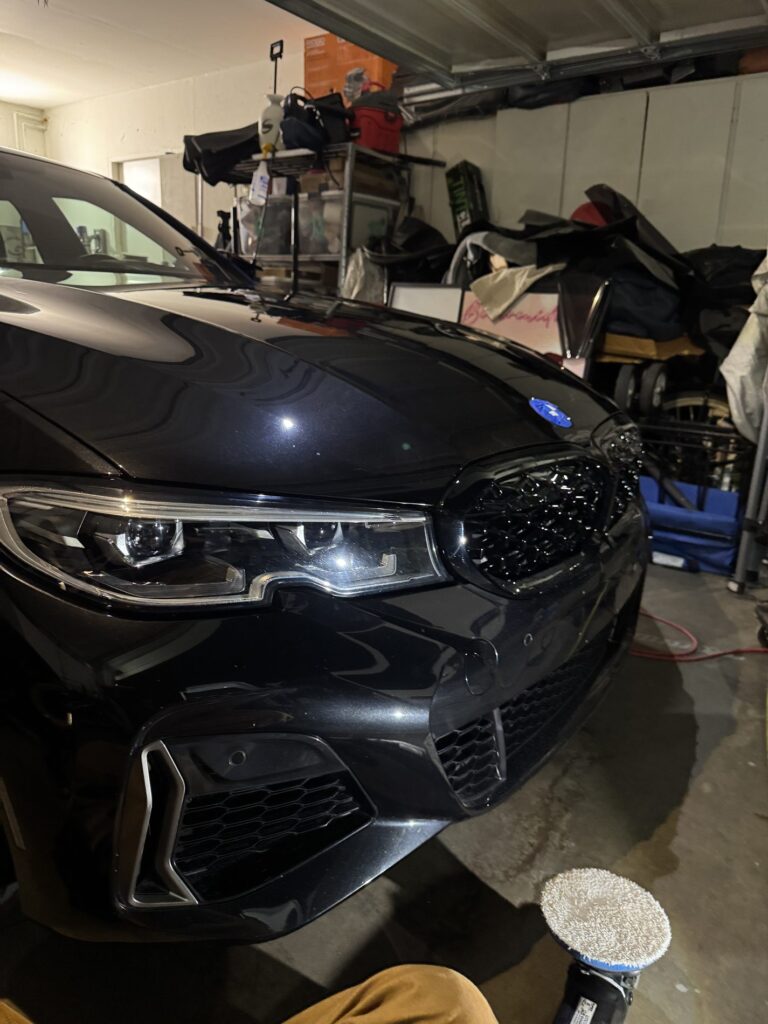
 Two-step correction, black M340i
Clay ‘n Seal Protection
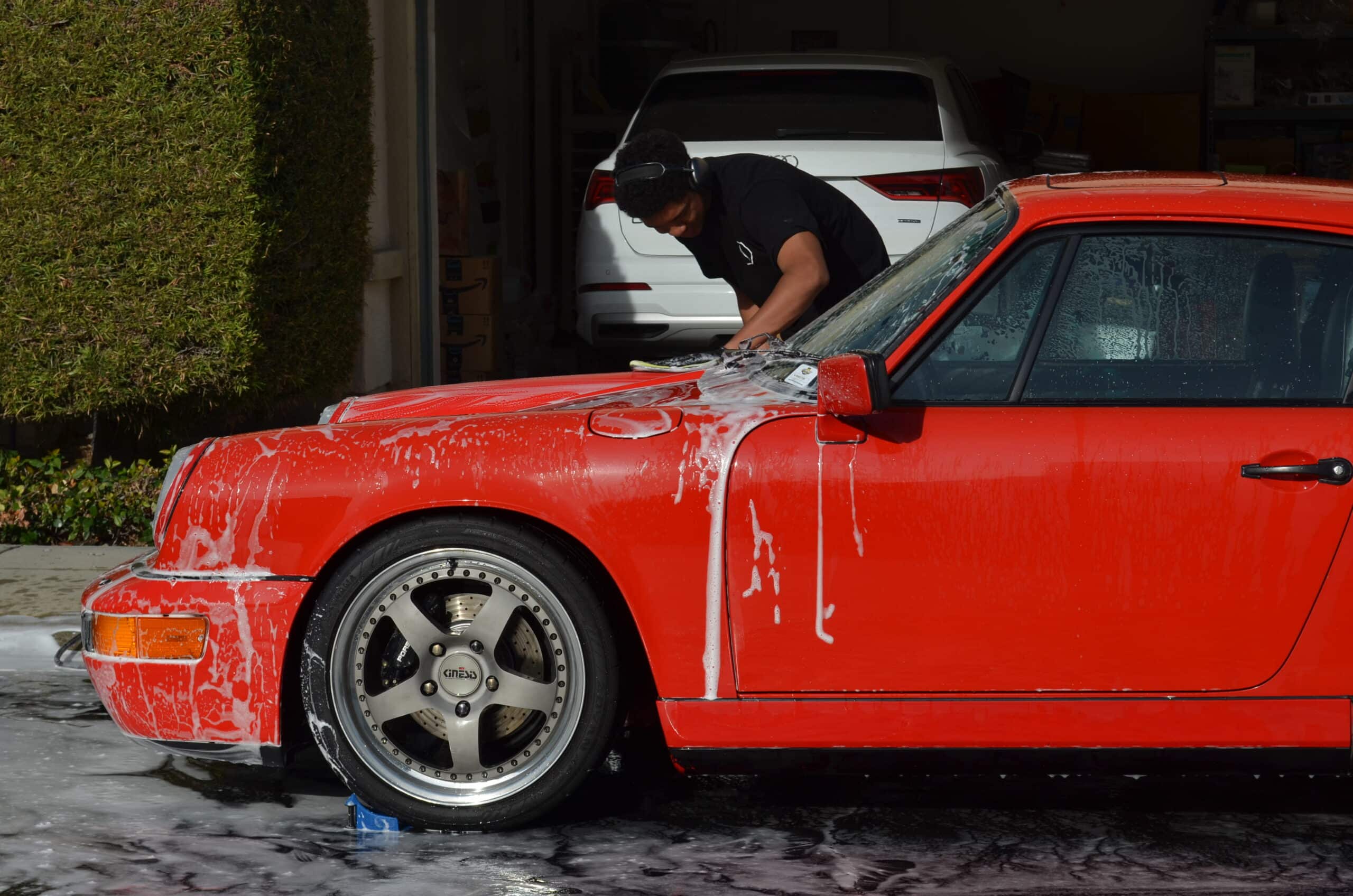
You get both halves of my Clay ‘n Seal built into the correction. The clay pass that pulls the grit out happens early, before any pad touches the paint. Then once the correction is finished, freshly polished paint is bare paint — so it gets sealed before I hand the car back.
- Clay pass to pull the grit out before correction begins
- Paint sealant applied to every corrected panel
- 5–7 months of protection out of the gate
- Water beads and rolls instead of spotting
Why It Matters
Three reasons this is worth doing once, properly, instead of twice on the cheap.
Worth doing once, properly.
Your paint only has so much clear coat
Every correction spends a little of it, and it does not grow back. Done properly once, it holds for years. Done cheap and repeated, you run out. Getting it right the first time is the whole point.
Every correction spends clear coat, and it does not grow back. Do it once, properly.

Swirls are what make a car look old
Not the year, not the mileage. A ten-year-old car with sharp reflections reads better than a two-year-old one covered in wash marks. Correction is the difference between the two.
Not the year or the mileage. Sharp reflections read newer than a low odometer.
Resale notices
Every service I perform is reported to CarFax. Documented paint work becomes a line on the history report that a buyer can actually see, which is not something a weekend buff can claim.
Every service is reported to CarFax, so the work shows on the history report.
Most swirls come from taking care of it.
Almost nobody scratches their own paint on purpose. It happens during the wash, using the same routine everyone is taught, and it is why a well-loved car often has more marring than a neglected one.
Almost nobody scratches their own paint on purpose. It happens during the wash.
The drive-through wash Worst offender
Those spinning brushes hold grit from every car ahead of you and drag it across your clear coat at speed. It is the single most common source of the swirl pattern people bring me, and touchless is not much better once the chemicals strip the protection off.
Spinning brushes carry grit from the last car and drag it across your paint.
One bucket and one sponge Every wash
The dirt you lift off the roof ends up back in the water, then back on the door. A sponge holds it against the paint instead of letting it fall. Two buckets, a grit guard and a proper mitt fix most of this for about thirty dollars.
Dirt from the roof goes back in the bucket, then back on the paint.
Drying with whatever is nearby Common
Bath towels, old t-shirts and chamois drag trapped particles in tight circles, which is exactly what a swirl is. A plush microfibre drying towel laid flat and pulled, not rubbed, does the same job without the marks.
Bath towels and t-shirts drag trapped grit in circles. That is a swirl.
Quick detailer on a dusty car Underrated
Spraying a waterless wash over dry dust and wiping it off grinds that dust across the surface. Between real washes, a rinse is safer than a wipe, and leaving it alone is safer than either.
Wiping a dry dusty car grinds the dust in. Rinse, do not wipe.
None of this makes you careless. It is what almost everyone is told to do. Correction resets the paint, and then the washing habits decide how long it holds — which is the part I will walk you through when I hand the car back.
This is what almost everyone is told to do. Correction resets it, and I will show you how to keep it that way.
Detail Designer
Spec your detail
Answer a few quick questions about your car and we will match you to the right service, with a real price and only the add-ons that actually apply. It takes about a minute.
How Pricing Works
Correction is priced by how many stages your paint needs. Tap a tier — or just keep scrolling.
One-Step Polish
A single machine polish that clears light swirls and haze and brings the gloss back. Right for well-kept paint that’s lost its edge.
Two-Step Compound & Polish
A cutting compound first to remove deeper swirls and scratches, then a refining polish to bring back full clarity. The most common correction.
Three-Step Correction
Wet sanding on the deepest defects, then compound, then polish — three separate passes over every panel. This is a two-day job at minimum, and on a large or badly neglected vehicle it runs longer. Nobody does this properly in an afternoon.
Vehicle size and paint condition move every number — a full-size SUV in rough shape takes more hours than a garaged coupe. Most corrections land between $500 and $2,000. The top of that range is a full three-step with wet sanding — a genuine two-plus day job, which is exactly why it costs what it does. You get the exact number at the inspection, and the $100 deposit comes off your price.
Three jobs people mix up.
One protects for a season. One removes the damage for good. One does both and holds it for years. Knowing which you actually want is most of the decision.
One protects for a season. One removes damage. One does both, for years.
Clay n Seal
Pulls the bonded grit out and seals. Real protection for a season, but it corrects nothing.
- Removes swirls No
- Light scratches No
- What it changes Cleaner, brighter
- Protection 5 to 7 months
- Time on the car 2 to 3 hrs
Paint Correction
Levels the clear coat so the defect is gone for good. This is the step that changes how the paint looks.
- Removes swirls Yes
- Light scratches Yes
- What it changes Deepest gloss possible
- Protection Sealant, 5 to 7 months
- Time on the car 6 hrs to 2 days
Ceramic Coating
Correction first, then a coating over it. Everything correction does, held for years. The most you can spend, and the most you get.
- Removes swirls Yes, correction included
- Light scratches Yes
- What it changes Deepest gloss, sealed in
- Protection 1 to 7 years
- Time on the car 1 to 2 days
A coating cannot skip the correction. It is optically clear, so it locks in whatever finish it goes over. That is why correction is built into every coating I install.
A coating locks in whatever is under it, so correction comes first every time.

The studio parks in your driveway.
The whole shop, in your driveway
Nothing gets downgraded because it is mobile. The same Rupes polisher, the same pads, the same Gyeon and Gtechniq chemicals, the same paint depth gauge I would use anywhere. The van is the shop, and it parks where you already are.
Same polisher, same pads, same chemicals, same gauge. The van is the shop.
Your car never goes anywhere
No drop-off, no second car, no week of wondering who is touching it. It stays in your own garage or driveway the whole time, and on a job that runs past a day it sleeps at home instead of somewhere across town.
No drop-off, no second car. It stays at home the whole time, even overnight.
You do not have to do anything
A flat place to park and room to open the doors is all I need. Water and power come with me. You can watch the whole thing from your kitchen window or forget I am there and get on with your day.
A flat spot and room to open the doors. Water and power come with me.
Why We’re Different
Confident enough to put it in writing


The Studio Comes to You
A fully equipped detailing van with our own water and power. Multi-day coating jobs happen in your driveway.

The Specialist, Not the Add-On
A dealership prep bay is measured on cars per day and a quick wash is measured on cars per hour, so neither is built to spend a day leveling clear coat. This is the only thing I do, on one car at a time, with professional equipment and premium Gyeon and Gtechniq chemicals rather than whatever moves the line fastest.
What it looks like in the driveway.
A black M340i, two stages, corrected panel by panel in the owner’s garage. Black is the hardest color to hide anything on, which is exactly why it is the one worth showing.
A black M340i, two stages, corrected in the owner’s garage. Black hides nothing.
A specialist, not a service department.
Paint correction is its own trade. A dealership prep bay and a quick-wash tunnel are built for volume, and they are good at volume. Leveling clear coat is a different job, done with different tools, measured in hours rather than cars per day. This is the one I do.
Correction is its own trade. Dealers and quick washes are built for volume. This is what I do.
Built for volume, and good at it.
- The clock is the product. A make-ready department is measured on cars per day, so a job that takes one person most of a day is simply not on their menu. That is a business model, not a failing.
- The wash is the prep. Most dealer reconditioning runs through an automatic wash and a quick machine pass with a glaze. That is what puts the swirls in, not what takes them out.
- Glaze buys time. Filler hides marring long enough for a test drive and a handshake. A few washes later it is back, and nobody involved is still on the hook.
- Nobody measures the paint. Without a depth gauge and a test spot, there is no way to know how much clear coat is there. Very few reconditioning bays own one.
- Coating packages skip the step. Paint protection sold in a finance office goes over the factory finish exactly as delivered, swirls included, because there is no time in the process to correct it first.
Built for one car, done properly.
- One car at a time. Yours has the whole day, which is the only way the hours exist to do this properly.
- Paint depth measured on every panel before a pad touches the car, then a test spot to find the least aggressive combination that clears the defects.
- Nothing gets filled. No glaze, no filler, no hiding. The defect comes out or I tell you it cannot, and you hear that at the inspection.
- Four-plus years on correction specifically — not general detailing with polishing bolted on. It is the trade, not an upsell.
- Fully insured, and I am the one who shows up. No call center, no service advisor, no handing your car to whoever is free that morning.
Different jobs, different people. This one is mine.
Different jobs, different people. This one is mine.
Serving Los Angeles & Orange County
Fully mobile — Cerritos, Whittier, Artesia, Bellflower, La Mirada, Buena Park, Norwalk, Long Beach, Lakewood and Cypress.
120+ Five-Star Reviews
Real reviews from Google and Yelp

I was long overdue for a thorough wash and detail. Jaycen did his thing! Made my 2012 car look shiny and new, both inside and out.

Would highly recommend Automotive Aptitude for anyone looking to get an amazing job done on their car! They were super professional, nice and did an amazing job with my car. I opted in for interior detailing and they did such a good job. Above and beyond my expectations, some of the best service I’ve ever got! Highly recommend.

You should definitely book an appointment! I got the clay and seal package, and the outside looked amazing. They did a great job on the inside too. Everything was perfect. They really took their time to make sure everything looked brand new.

Professional, amazing service, and great prices. You can’t ask for much when you need a last minute appointment right before a road trip, but Jaycen was able to squeeze me in and knock it out of the park. The guys even showed up early and knocked out a clay bar, seal, and even got rid of a pesky scratch in record time. My car looked like it rolled out of the dealership again. Amazing work!

One satisfied customer here! My first time ever having my car serviced and detailed, and I am definitely going to book again. Jaycen was really professional and very nice, and I was amazed with his service truck too.

Jaycen was amazing — very polite, professional, and knowledgeable. My brand new Tesla Model 3 is looking gorgeous after a seven-year ceramic coating done by him. I will recommend this young man 100%. Very, very high work ethic.
Take It Further
Frequently Asked Questions
How do I know if my car needs paint correction?
Park it in direct sunlight and look at the paint. Spider-web swirls, a cloudy haze, or a reflection that looks soft instead of mirror-sharp means the clear coat is scratched up — that’s what correction fixes. If the car just looks dirty or dull from grime, a regular detail may be all it needs. I’ll tell you which one you’re looking at, straight.
How do I know if my paint is too far gone?
Two checks. If a scratch catches your fingernail, it’s through the clear coat — polishing can’t remove it. And if the clear coat itself is peeling, flaking, or burned through (white or dull patches that look like the finish is coming off), that’s a repaint, not a correction. I’ll tell you before I start, not after.
Is it safe for my paint?
Done properly, yes. I measure your clear coat with a paint thickness gauge before touching anything, test a small spot first, and always use the gentlest combination that clears the defects. I’m fully insured. The people who burn paint are the ones who skip those steps.
How long do the results last?
The removal itself is permanent — those scratches are gone, not hidden. New swirls only show up the same way the old ones did: from washing habits. Your correction leaves with a sealant already on it, and careful hand washing keeps it sharp for years. A ceramic coating stretches that even further.
Will it fix faded or oxidized paint?
Usually, yes. Oxidation and UV haze live in the top of the clear coat, and polishing cuts down past them — dull, chalky paint often comes back deeper than owners expect. Heavy fade on older single-stage paint needs a look first, which is exactly what the inspection is for.
Do I need to have anything ready when you arrive?
No. The van carries its own water, power, lighting, and every tool the job needs. All I need from you is a flat place to park and access to the car for the day.
Do you require a deposit?
Yes. A $100 deposit secures your appointment and goes toward the final price of your correction. It confirms your date and the time we block out for your vehicle.
How many times can my car be polished before the clear coat is gone?
There is no fixed number, and anyone who gives you one is guessing. Clear coat is thin, and every correction takes a little of it. A careful correction takes the least that will do the job. That is the argument for correcting once and then protecting it, rather than polishing every year.
Will paint correction remove the scratches on my car?
It removes what sits in the clear coat — swirls, buffer trails, water-spot etching, most light scratches. If your fingernail catches in it, it has gone through the clear, and polishing will soften it rather than erase it. I will tell you which one you are looking at before I start, not after.
What is the difference between one-stage and two-stage correction?
One stage is a single cutting-and-finishing pass, and it lifts most light swirling. Two stage adds a dedicated cutting step before the finishing polish, for deeper defects. Which one your car needs is a paint-condition question, and I answer it at the car.
How much does paint correction cost?
From $500, and up to about $2,000. That spread is real work, not padding — a garaged coupe with light swirls is a different day from a full-size SUV that has been through tunnel washes for six years. Paint depth and defect severity drive the hours, and neither shows up in a photo, so I quote after an inspection. A $100 deposit holds your date and comes off the final price.
Does my car need correction, or just a good wash?
Pull it into direct sun and look at the reflection on the hood. Fine circular scratches mean swirling, and only polishing removes those. If it just looks dull and feels rough, a Clay ‘n Seal at $180 will do more for you than a correction will — and I will say so rather than sell you up.
Let’s Talk Details
The best way to find out more information is to talk to me.
Fill out your information and I will get back to you personally to help you out.
We’ll never share your info with anyone